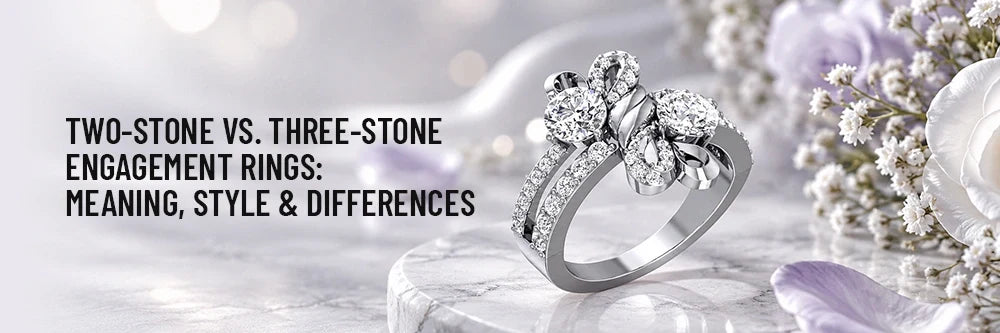
Many newly engaged couples love to show off their solitaire engagement rings. While this is one of the more popular formats, modern two-stone and three-stone designs are steadily gaining popularity. In fact, some find them far more meaningful when compared to a solitaire.
Two-stone and three-stone designs carry symbolism that a single center diamond simply can’t, and they offer a different visual rhythm on the hand. The two styles get confused for each other more often than they should, given how differently they’re actually built and what they’re meant to represent.
What Two-Stone Rings Represent
Two-stone rings, sometimes called “toi et moi,” French for “you and me,” feature two diamonds or gemstones set side by side, usually of equal or near-equal size. The style dates back centuries, with one of its most famous modern moments being a 2021 celebrity engagement that reintroduced the toi et moi style to a much wider audience.
The symbolism is fairly direct: two distinct stones, set together but each visible in its own right, representing two individuals joined in partnership without losing their individual identity.
Unlike a three-stone ring, which leans on a past-present-future narrative, the two-stone design is really just about the pairing itself. It’s a more modern, less traditional choice, and it tends to appeal to people who want engagement ring symbolism without leaning on a decades-old convention.
What a Three-Stone Diamond Engagement Ring Represents
The three-stone ring is built around a well-known narrative: the center stone represents the present, and the two flanking stones represent the couple’s past and their future together. This meaning became widely popularized through a De Beers marketing campaign in the late 1990s, similar to how the “two months’ salary” guideline traces back to earlier advertising from the same company, though the three-stone format itself predates that specific campaign by decades.
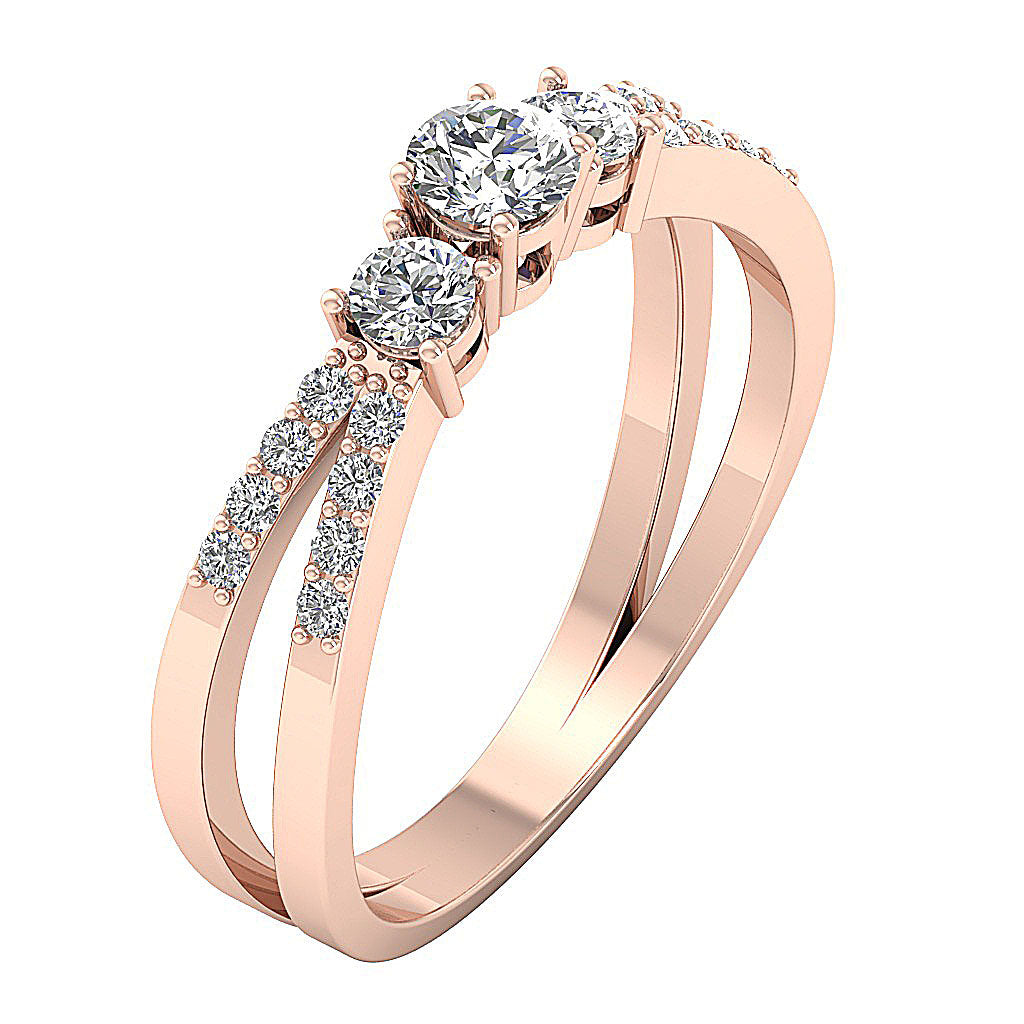
Structurally, three-stone rings almost always feature a larger center diamond flanked by two smaller, matching stones, which can be diamonds or colored gemstones. This creates a natural visual hierarchy that two-stone rings don’t have, with the eye drawn first to the center and then outward to the sides.
It’s a more traditional silhouette, and it remains one of the most consistently popular engagement ring styles across generations.
How the Aesthetics of the Two Designs Vary When They Are Worn
Two-stone rings tend to read as more balanced and symmetrical from a design standpoint, with two stones of similar visual weight sitting next to each other. This creates a wider, more horizontal look across the finger, which some people find especially flattering on shorter fingers. The design draws the eye across the ring rather than up.
Three-stone rings, by contrast, build in a clear hierarchy among the diamonds. The center stone is meant to be noticed first, with the side stones providing support and contrast rather than competing for attention. This design tends to make the center diamond appear slightly larger than it would in a plain solitaire, since the smaller flanking stones provide a size comparison that emphasizes the center stone’s scale.
Choosing Stone Shapes and Combinations
Two-stone rings work particularly well when the two stones are cut differently from each other, a pairing sometimes called a “toi et moi” contrast, such as an oval next to a pear, or a round next to a cushion cut. This asymmetry in shape, paired with symmetry in size, is part of what makes the style feel distinct from more traditional pairings.
Three-stone rings generally call for more uniformity. The two side stones are almost always matched to each other in shape and size, even when they differ from the center stone’s cut.
A round center stone is usually flanked by two trapezoid or baguette side stones. The two side stones themselves should mirror each other closely, since any mismatch between them is far more noticeable than a mismatch between a two-stone pairing.
Picking Your Diamond Engagement Ring: Which Style Fits Which Personality
Someone drawn to a two-stone ring is often looking for something that feels less bound to convention. It suits people planning a modern, less traditional wedding, and appeals to couples who like the idea of a ring that tells a simpler, more personal story rather than leaning on an established meaning.
Two-stone rings also photograph distinctly, with their horizontal, side-by-side silhouette standing out from more conventional solitaire and halo styles.
Someone drawn to a three-stone ring often wants a design that carries built-in meaning without having to explain it, since the past-present-future symbolism is widely recognized. It also suits people who like a more classic silhouette but want more visual presence than a solitaire alone provides. The added side stones increase the ring’s total sparkle and total carat weight without necessarily requiring a larger, more expensive center stone.
How Band and Metal Choice Interact With Each Style
The band itself plays a bigger role in these two styles than it does in a simple solitaire, since it’s doing more work to unify multiple stones into a single cohesive design.
In two-stone rings, a thin, understated band tends to keep the focus on the pairing of stones rather than competing with them, while a more textured or twisted band can visually connect the two stones and reinforce the “joined together” symbolism.
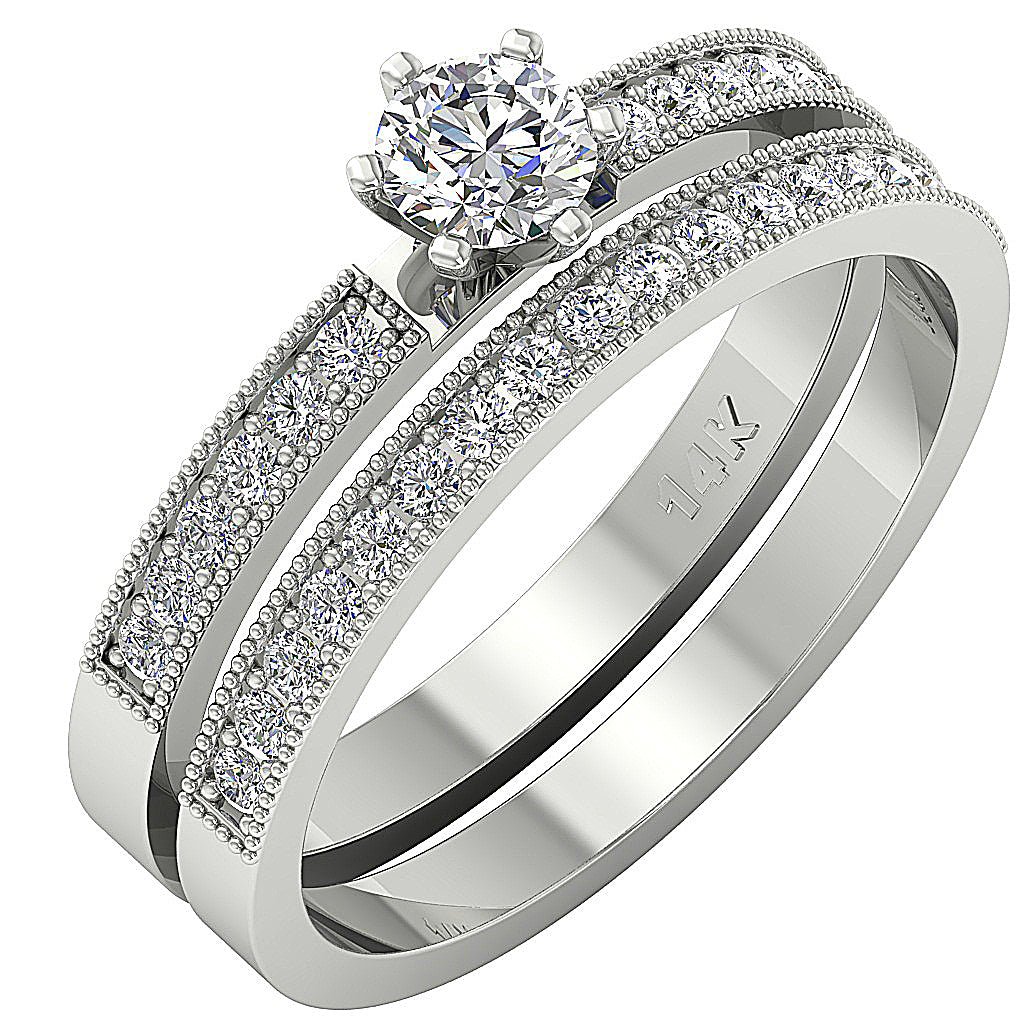
Three-stone rings often use a slightly wider band to accommodate the setting for the side stones, and the band frequently tapers, widening near the center stone and narrowing toward the shank.
Metal choice, too, is important. White gold and platinum tend to make the side and center stones read as a unified block of brilliance, while yellow or rose gold introduces the warmer contrast that can make each stone more distinct against the metal.
Practical Factors to Evaluate Before You Buy
Two-stone rings require more careful matching between the two center stones, since they sit at equal visual weight and any difference in color, clarity, or cut quality between them will be immediately apparent side by side. It’s worth asking a jeweler specifically how the two stones were matched, and requesting to see both certificates rather than just one.
Three-stone rings involve a similar matching consideration for the side stones, though with slightly more forgiveness since they’re smaller and less central to the design. Budget-wise, three-stone rings typically require a larger total carat weight across three stones rather than two, which can push the overall price higher than a comparable two-stone design, depending on how the carat weight is distributed.
Sizing and resizing also differ slightly between the two. Three-stone rings, particularly those with side stones set low on the band, can be somewhat more complex to resize than a two-stone design, since resizing sometimes affects the setting of the side stones. It’s worth discussing this with a jeweler at the time of purchase if a future resize seems likely.
Personalising Either Style Beyond the Standard Format
Neither style has to follow the standard formula exactly.
Two-stone rings sometimes incorporate a birthstone alongside a diamond rather than two diamonds, personalising the “you and me” symbolism with a stone tied to a specific birth month or family connection.
Three-stone rings can substitute anniversary or birthstone gems for the traditional matching diamonds on either side, shifting the meaning from a generic past-present-future narrative to something tied to a specific date or milestone in the couple’s actual relationship.
Engraving inside the band is another common way couples personalize either style further, adding a date, initials, or a short phrase that doesn’t show outwardly but adds meaning known only to the wearer. This kind of detail costs very little relative to the ring itself and is worth asking about at the time of purchase, since not every jeweler engraves rings after the fact with the same ease as before the setting is finalized.
Wrapping Up
Both styles offer something a solitaire can’t: a design built around a relationship rather than a single stone. Diamond for Good’s engagement ring collection includes two-stone and three-stone options for those who want to compare the two in person before deciding which one fits.
Frequently Asked Questions
Can a two-stone or three-stone ring use colored gemstones instead of all diamonds?
Yes, both styles commonly pair diamonds with sapphires, emeralds, or other gemstones. This is especially popular in two-stone rings, where contrasting a diamond with a colored stone reinforces the “you and me” symbolism through color as well as shape.
Is one style considered more formal than the other?
Three-stone rings generally read as more traditional and formal, given their established symbolism and classic silhouette. Two-stone rings feel more contemporary and personal, though neither style is inherently more or less appropriate for any particular wedding style.
Do three-stone rings cost more than two-stone rings at the same total carat weight?
Not necessarily, though the added complexity of matching three stones rather than two can add modestly to labor costs. The bigger price driver is typically the size and quality of the individual stones rather than the stone count itself.
Can side stones be added to an existing solitaire later?
In many cases, yes, though it depends on the setting’s design and whether it was built to accommodate additions. A jeweler can advise on whether an existing solitaire can be converted into a three-stone or two-stone style without compromising the setting’s structure.


Leave a comment
This site is protected by hCaptcha and the hCaptcha Privacy Policy and Terms of Service apply.