
Ask a stylist what belongs in every wardrobe and the answer is never a trend. It is a white shirt, a good pair of jeans, and a pair of diamond stud earrings that can walk into a boardroom, a wedding or a late-night kitchen without changing a thing.
Diamond stud earrings suit every gender, every age and every ear, which is exactly why choosing a pair is harder than it looks. The difficulty is that the same carat number can describe two pairs that look nothing alike. Setting, shape, cut and the backs on the posts all change the result.
This is a guide built in two layers: first the carat sizes, then the settings, so that what you order matches what you picture.
What Does Carat Weight Mean For Diamond Stud Earrings?
Carat measures weight, not size. One carat is 200 milligrams, and a stone's diameter depends on how it is cut. That is why jewelers talk in millimeters when they want you to picture a stone.
Pairs are almost always sold by total weight, written as ctw. A one-carat pair contains two half-carat stones, not two one-carat diamonds. This single detail catches a lot of first-time buyers unaware, who expect a headline number to describe each ear. That’s why you should read the listing carefully and confirm whether the figure is per stone or for the pair.
The quality of the cut is also very important and impacts brilliance. A well-proportioned round stone spreads its weight evenly and looks lively face-up. A stone cut too deep hides weight underneath, so it looks smaller than its carat suggests, and one cut too shallow looks larger but leaks light and turns dull.
Which Carat Size Should You Choose?
These are approximate diameters for well-cut round stones, and they vary a little with proportions.
A quarter-carat pair, meaning two stones of about 0.12 carat each, measures roughly three millimeters per stone. It is delicate, easy to forget and ideal for a second or third piercing, or for people who prefer something barely there.
A half-carat pair has stones of 0.25 carat each, around four millimeters. This is the classic starter size, quiet enough for an office and daytime wear.
A one-carat pair has two half-carat stones, roughly five millimeters each. Many people consider this the sweet spot. It reads as deliberate, it photographs well, and it still sits comfortably on a small lobe.
A pair of one and a half carats, about 5.8 millimeters per stone, announces itself. At two carats total, each stone is about 6.4 millimeters, and the earrings become a feature of the outfit rather than a finishing touch.
Choose by lifestyle rather than ambition. If you sleep in your earrings, chase toddlers or work with your hands, smaller stones are more comfortable. If you wear studs for evenings out, go bigger and enjoy it.
How Does the Setting Change How Big a Stud Looks?
The setting is the metalwork that holds the diamond, and it alters the visual size more than most buyers expect. A low, tight setting makes a stone look larger because less metal competes with it. A tall, bulky basket does the opposite, adding height and hiding some of the diamond's edge.
Prongs lift the stone and let light enter from the sides, which maximizes sparkle. Bezels wrap the stone in a thin rim of metal, which looks sleek and modern but covers a sliver of the edge. Halos surround the center stone with smaller diamonds, adding width and glitter at the cost of a more ornate look.
Think of the setting as the frame. The same painting looks different in a thin black edge and a thick gilded one.
What are Martini Diamond Studs, and Why Do They Look Larger?
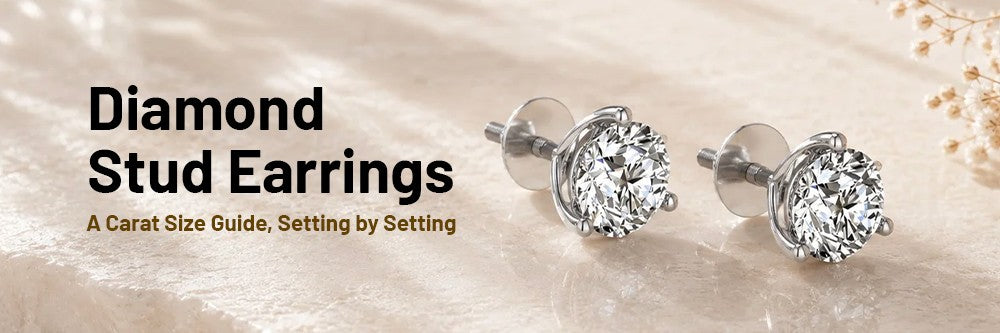
Martini diamond studs take their name from the glass. The setting is a tapered, cone-shaped cup, with three or four prongs rising from a narrow base, so the stone sits like an olive in a martini. It rests low against the ear and uses very little metal.
That minimal profile is the secret. Because the stone sits flush and the metal stays out of the way, martini diamond studs let almost the full face of the diamond show, and light enters from all sides. The pair looks a little larger than the same carat weight in a bulkier basket, and it keeps a clean silhouette in profile.
There is a trade-off. Three-prong versions show the most diamond but offer slightly less protection, and any prong setting needs an annual check.
When Does A Bezel Or Halo Make More Sense?
A bezel is the better choice for someone with an active lifestyle. The surrounding rim protects the stone's edge and doesn’t snag on anything. As a result, it suits runners, parents and people who handle bags and scarves all day. It also gives a cooler, more architectural look that many people prefer to the traditional sparkle of prongs.
A halo is beautiful but quite the opposite. By ringing the center diamond with smaller stones, it adds visual diameter, so a modest center looks like a bigger one. It is a clever route to presence without paying for carat weight, though the effect is more decorative and less minimal.
Some people want flexibility. Removable jackets slide behind a pair of studs to change their character, turning a plain pair into a glamorous one for the evening.
Which Earring Back Is Safest and Most Comfortable?
Backs get far less attention than stones, and they deserve more. Push backs, the friction kind, are the most common. They are comfortable and easy to use, but they can loosen with wear, so check them regularly. Screw backs thread onto the post and hold far more firmly, which is what most jewelers recommend for larger or more expensive pairs.
Leverbacks use a hinged closure and are especially secure. If you have heavy lobes or a history of losing one earring from a pair, a locking back is an effective precaution.
The material of the earring counts too. If your ears are sensitive, ask about the metal of the post, and look for solid gold rather than plated alloys.
How Do You Match Diamond Stud Earrings To Your Ears And Your Life?
Start with the ear, not the online store or catalog. A small lobe, a cartilage piercing and a large lobe all take different sizes comfortably. Heavier studs can pull on a lobe over a long day, and a stone that looks lovely in a photograph can feel intrusive after hours of wear.
Next, look at the rest of what you wear. People who stack rings, bracelets and necklaces often choose a half-carat or one-carat pair, because the earrings should support the look, not compete for attention. People who wear very little jewelry can afford larger stones, since the studs carry the whole effect.
Do not feel bound by old conventions either. Wearing a single stud, mixing two sizes or placing a pair along several piercings is a perfectly modern way to wear diamonds.
How Do You Care For Your Beloved Diamond Stud Earrings?
Wipe them clean with a soft cloth after wearing. Soak them in warm water with a drop of mild soap once a month and brush gently behind the stone, where skin oil and hairspray collect and dull the sparkle. Store the pair in separate compartments so the posts do not scratch each other.
Have the settings checked by a jeweler once a year. Prongs wear down over time, and a stone that is secure today can loosen in twelve months of regular use.
Wrapping Up: What Is the Smartest Way To Buy?
Insist on an independent certificate for the stones, ask whether the pair is matched in color and clarity, and look at the cut grade before the carat. Confirm the return policy before you buy, and wear the pair for a few days to see how the weight sits. A pair that you reach for every morning is worth more than one that sits in a box.
Budget deserves an honest look as well. Spending a little less on carat and a little more on cut, color and a solid gold post usually produces a better pair than chasing the biggest number you can afford. A slightly smaller, brilliant pair beats a larger, lifeless one every time. Light is what people notice, not paperwork.
At Diamond for Good, we carry an extensive collection stud earring made from natural and/or lab-grown diamonds.
Frequently Asked Questions
Does carat weight refer to each earring or the pair?
Most listings show total weight for the pair. A one-carat pair holds two half-carat diamonds, so always confirm whether the number is per stone or combined before you buy anything.
Are martini diamond studs better than basket settings?
Martini settings sit lower with less metal, so the diamond looks slightly larger and brighter. Basket settings add height and protection, so the better choice depends on your own lifestyle.
Which earring back is the most secure?
Screw backs and leverbacks grip most securely, which makes them wise choices for larger pairs. Push backs are comfortable but can loosen, so check them often and tighten when needed.
How can I make diamond stud earrings look bigger?
Pick a low martini or halo setting, a well-cut stone, and a slightly wider shape. Cut quality and a minimal metal frame often add more visual size than extra carats.

Leave a comment
This site is protected by hCaptcha and the hCaptcha Privacy Policy and Terms of Service apply.